


Amethyst Tales
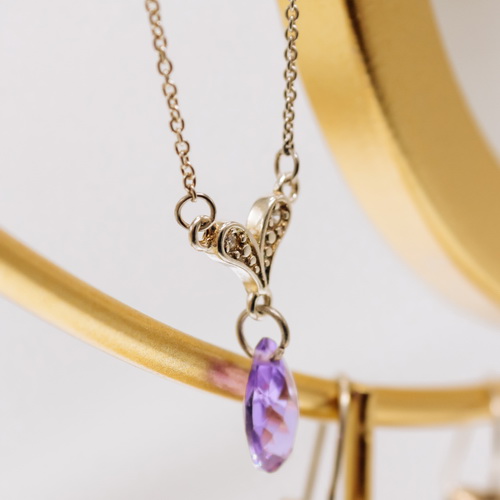
The Lore of Amethyst: Where Mythology Meets Antiquity
Gemstone legends are not merely stories for children; they offer a fascinating glimpse into the cultural and historical tapestry of the ancient world. Among the most captivating of these are the myths surrounding the amethyst, a stone celebrated for millennia for its striking violet hues and protective lore.
A Measure of Moderation in Ancient Greece
In ancient Greece, wine was consumed vastly differently than it is today. Often thick, highly potent, and fortified with pine resin, the unadulterated drink was overwhelmingly strong. Because public drunkenness was heavily stigmatized and considered shameful, the Greeks adopted the civilized practice of diluting their wine with spring water.
Historical Note: To achieve the perfect, socially acceptable balance of wine and water, the Greeks used the amethyst as a visual guide. The ideal dilution was reached when the beverage perfectly matched the pale, lilac-purple shade of the gemstone.
The Greek Myth: The Tears of Dionysus
According to Hellenic lore, there once lived a breathtakingly beautiful nymph named Amethyst. As an eternally young deity of nature, her grace caught the eye of Dionysus, the god of wine and revelry. However, Amethyst did not return his affections, harboring love instead for a humble shepherd.
Unable to accept her rejection, a relentless Dionysus pursued the nymph, determined to force her hand. In her desperation, Amethyst prayed to Artemis, the goddess of the hunt, for salvation. To protect the girl from the god's aggressive advances, Artemis transformed her into a magnificent statue of pure, white quartz.
When Dionysus discovered the statue, his anger melted into profound sorrow. In a futile attempt to revive his beloved, he poured his finest dark wine over the pale stone. The statue absorbed the vibrant liquid, transforming into a brilliant, translucent purple. Thus, the amethyst was born—forever revered as a talisman to protect true lovers and ward off the intoxicating effects of wine.
The Roman Variant: The Wrath of Bacchus
A parallel legend from ancient Italy offers a darker twist on the stone's creation. Bacchus, the Roman equivalent of Dionysus, grew enraged by the disrespect shown to him by mortals and swore vengeance. He decreed that the first human to cross his path would be devoured by his fierce lions.
Tragically, this innocent mortal was Amethyst, a young maiden on her way to worship at the temple of Diana. Seeing the girl's impending doom, Diana intervened, turning her into a pristine, clear crystal to shield her from the lions' claws. Realizing the cruelty of his rash decree, Bacchus poured his wine over the crystal in remorse, forever staining the stone a deep, majestic violet.
An Enduring Legacy
Long before precious stones were routinely faceted into the intricate designs we see today, amethyst held a unique place in human history. It was one of the very first crystals prized exclusively for jewelry and adornment rather than for crafting weaponry or tools. Today, its enchanting color continues to captivate, carrying with it the echoes of ancient gods, legendary romance, and the timeless pursuit of balance.